


After expanding into a new state, a leading urgent care clinic group saw patient acquisition decline. Here is how our urgent care SEO services and healthcare PPC management team approached it, and the three patient metrics the page reports.
Client
CareNow, a top urgent care clinic group in the US
Industry
Urgent care and healthcare
Services
Urgent care SEO services, paid search (healthcare PPC management), programmatic advertising, competitor and market analysis
Scope
Seven audience and placement targets across organic search, paid search and programmatic channels
Headline result
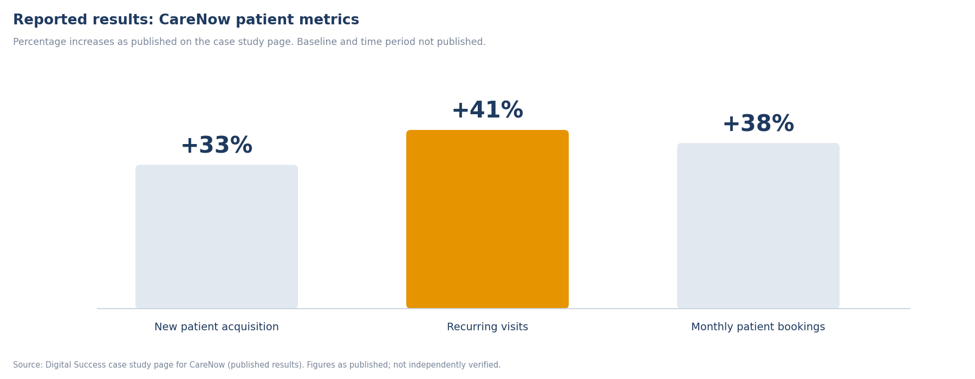
+33% new patient acquisition, +41% recurring visits and +38% monthly patient bookings (as reported on the source page)
CareNow asked Digital Success to increase its daily patient count after expanding into a new state. The strategy began with a competitor and market analysis, then combined SEO, programmatic advertising and paid search to put CareNow in front of new patients, competitors' patients and past patients. The page reports +33% new patient acquisition, +41% recurring visits and +38% monthly patient bookings.
+33%
new patient acquisition
+41%
recurring visits
+38%
monthly patient bookings
The challenge: a new state, falling patient acquisition and a limited footprint online
Urgent care clinics face a particular set of marketing problems. They need to stay top of mind so potential patients think of them first, they need to be found online so searchers become patients, and they need to be in front of people at each relevant digital touch point and on the right device.
CareNow had just expanded into a new state, and patient acquisition began to decline because of a lack of brand awareness, low market penetration and weak local search rankings. Website traffic was almost all coming from the service locations of its original clinics, so the missing element was visibility in the new markets. CareNow asked whether Digital Success could increase its daily patient count.
Our urgent care marketing approach: eight documented actions
The strategy had two priorities: acquiring new patients and increasing recurring visits from past patients. It was built on a highly mobile patient base. The table summarizes the strategy and the placements it set out to win.
| Action | What we did |
|---|---|
| 1. Competitor and market analysis | The strategy began with an analysis of competitors and the market, so the later work was based on the landscape rather than assumptions. |
| 2. Organic search | Combined SEO tactics so CareNow appeared in non-sponsored (organic) search results. |
| 3. Paid search | Used paid search methods so CareNow appeared in sponsored search results. |
| 4. Relevant placements | Made sure CareNow was present in highly relevant places, such as blogs recommending the best urgent care centers. |
| 5. Right touch points | Reached the target audience at the right digital touch points, using programmatic advertising alongside search. |
| 6. Competitors' patients | Put CareNow in front of patients of competing urgent care centers. |
| 7. Past patients | Stayed in contact with past patients to increase recurring visits. |
| 8. Service-area targeting | Targeted people in the service areas relevant to each CareNow clinic. |
The starting point: traffic that came from the old footprint
The documented problem was specific. Website traffic was almost all coming from the service locations of the original clinics, which meant the new state was largely invisible online. Nothing in the strategy was aimed at the existing clinics. It was aimed at the markets where CareNow was not yet being found.
The page then explains why the solution worked: being found by people with the intent to visit an urgent care center led to a higher rate of walk-ins, and targeting service areas around the clinics with relevant ads built brand awareness and, in turn, patients.
How to read the sections that follow. Each section carries a tag. Campaign evidence means activities documented in this engagement. Industry context and recommended practice are general guidance from Digital Success; they were not measured in this campaign and are not results.
Why Urgent Care Is a Local, Intent-Driven Search Problem
CAMPAIGN EVIDENCE + INDUSTRY CONTEXT
People rarely plan an urgent care visit. They search when they need care, usually from a phone and usually near a location. That is why the documented strategy focused on being found in organic results, in sponsored results and in the service areas around each clinic at the moment of need, instead of relying on brand awareness alone.
The CareNow page draws the same connection: being found by people with the intent to go to an urgent care center led to a higher rate of walk-ins, and being found easily in search results brought more traffic to the CareNow website, of which a good percent decided CareNow was a good fit. Those are the page's own explanations, not separately measured findings.
Is your urgent care brand visible in new markets?
Get a review of your local rankings, paid search coverage and service-area targeting before you open or expand.
Reported results: three patient metrics
CAMPAIGN EVIDENCE
The case study page reports three percentage increases in patient metrics, shown below as published.
Healthcare PPC Management Services: Search and Programmatic Working Together
CAMPAIGN EVIDENCE + RECOMMENDED PRACTICE
Documented: the strategy combined paid search with programmatic advertising, and used both to reach people in clinic service areas, patients of competing clinics and past CareNow patients.
Recommended practice for any urgent care paid media program:
- Plan by clinic, not only by brand. Give each location its own service area, budget and landing page.
- Treat past-patient audiences carefully. Check privacy and compliance requirements with your legal team before using patient data for advertising.
- Keep hours and wait information accurate. Ads and listings that send people to a closed clinic lose the patient.
- Measure visits, not just clicks. Track calls, directions requests and booked visits so you can see what paid media is producing.
Need healthcare PPC that brings patients through the door?
Tell us your clinic locations and service areas, and we will plan how paid search and programmatic can work with your SEO.
What Other Urgent Care Brands Can Learn From This Campaign
CAMPAIGN EVIDENCE, THEN RECOMMENDED APPLICATION
| Lesson | What happened here (documented) | How to apply it (recommended) |
|---|---|---|
| Start with the market | Strategy began with a competitor and market analysis | Map competitors by service area before choosing channels |
| Cover organic and paid together | CareNow was placed in both non-sponsored and sponsored results | Use paid search to fill gaps while local SEO builds |
| Reach new markets deliberately | Traffic came almost entirely from the original clinics | Build location pages and local signals for each new market |
| Win patients from competitors | CareNow was put in front of competing clinics' patients | Set up competitor and location audiences with clear exclusions |
| Bring past patients back | Past patients were contacted to increase recurring visits | Create a recall plan, within privacy rules |
Key takeaways for urgent care marketing
- Visibility follows the footprint. After a move into a new state, traffic still came from the old clinics until marketing was aimed at the new markets.
- Two goals, two audiences. The strategy targeted new patients and past patients at the same time.
Frequently Asked Questions
Urgent care marketing is the work of helping an urgent care clinic get found by people who need care now and bringing past patients back. It typically combines local SEO, paid search, programmatic advertising and reputation work, planned around each clinic's service area.
The team began with a competitor and market analysis, then combined SEO, programmatic advertising and paid search. The aim was to place CareNow in organic and sponsored results, on relevant blogs, in front of competing clinics' patients, in front of past patients and across the service areas of its clinics.
The page reports +33% new patient acquisition, +41% recurring visits and +38% monthly patient bookings. It does not state the time period or the baseline numbers, so the percentages should be read as reported figures.
Each channel reaches people at a different moment. SEO builds organic visibility over time, paid search captures immediate intent, and programmatic advertising reaches people across relevant sites and devices. The CareNow strategy used all three.
Need more patients for your urgent care clinics?
Our team will review your local visibility and paid media and show you where patients are being missed.
Talk to our urgent care marketing team Call +1-855-344-4821