




Two restaurants, two different audiences, and one month to show results. Here is how paid and organic marketing worked together to drive footfall.
Client
Corner Station, a Texas restaurant group with two locations
Industry
Restaurants / hospitality
Services
Social media marketing, content marketing, programmatic advertising (paid and organic)
Goal
Drive footfall to both restaurants, with visible results within a month
Headline result
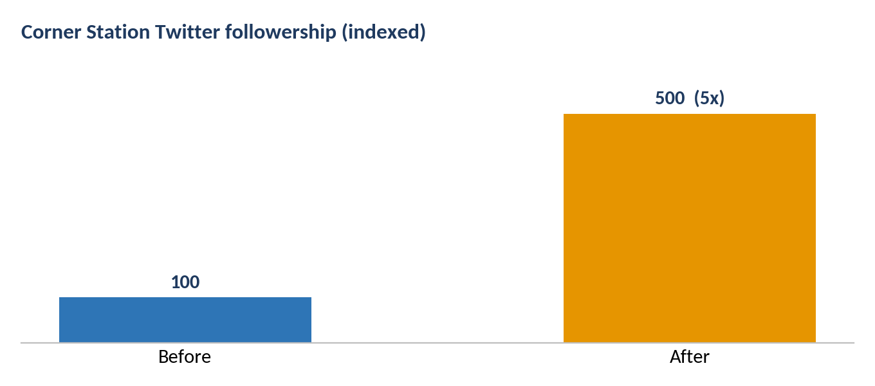
5x increase in Twitter followership
The short version
Digital Success grew Corner Station's Twitter following 5x with a mix of sponsored Facebook and Twitter posts, blogs written by a well-known food blogger and the restaurant's chef, and programmatic push notifications to potential customers near the restaurant.
5x
Twitter followership
2
restaurant locations
1 month
client's target for visible results
The challenge: two restaurants, two audiences, one month
Corner Station, based in Texas, owns restaurants in two locations. It wanted a trusted Dallas digital marketing agency to deliver a complete, aggressive digital marketing strategy for restaurants, and it wanted to see results within a month. The two restaurants served different sets of customers, so one message wouldn't fit both.
Our restaurant digital marketing approach: paid and organic, aimed at footfall
We built a strategy of social media marketing, content marketing and programmatic advertising for each restaurant, combining paid and organic tactics to drive more people through the door.
| Tactic | What we did |
|---|---|
| Paid social | Sponsored posts on Facebook and Twitter |
| Content with a local voice | Engaged a well-known food blogger and the restaurant's chef to write blogs for the restaurants |
| Programmatic advertising | Sent push notifications to potential customers near the restaurant locations |
The results
| Metric | Result |
|---|---|
| Twitter followership | 5x increase |
How to read the sections that follow. Each section carries a tag. strong means activities and results documented in this engagement. Industry context and recommended practice are general guidance from Digital Success; they were not measured in this campaign and are not results. Illustrative examples are labeled as such and are not client data.
How Diners Search for Restaurants
INDUSTRY CONTEXT + ILLUSTRATIVE EXAMPLES (NOT CLIENT DATA)
Restaurant search is local, mobile and immediate. Diners look for somewhere to eat nearby, check menus, hours and reviews, and decide quickly. The formats below are illustrative.
| Search pattern | Illustrative format | What the diner wants | Where visibility comes from |
|---|---|---|---|
| Proximity | "restaurants near me" | The nearest options | Google Business Profile, local results |
| Cuisine and place | "[cuisine] restaurant in [city]" | A fit for taste and area | Location pages, listings |
| Occasion | "[occasion] restaurant [city]" | A place for a specific need | Event, private dining and menu pages |
| Menu or dish | "[restaurant] menu" | What is on offer and at what price | A text menu page |
| Practical details | "[restaurant] hours", "reservations" | A quick answer | Business profile and site header details |
| Chef and story | A chef's or blogger's name | Context and credibility | Blog posts and social profiles |
Corner Station's documented scope was social media marketing, content marketing and programmatic advertising. Local search listings and Google Business Profile management are not described in the case study, so nothing here claims local search results.
Want to reach diners when they are nearby?
See how programmatic advertising can send timely messages to potential guests close to your restaurant.
Restaurant Website Pages That Attract Traffic
CAMPAIGN EVIDENCE + RECOMMENDED PRACTICE
Restaurants with more than one location have a specific search challenge: each location competes for its own local searches, and one page cannot serve both. Corner Station's two restaurants served different customers, which the campaign addressed in its messaging (documented).
| Page | What it should contain | Status in this campaign |
|---|---|---|
| A page for each location | Address, phone, hours, menu, parking and reservation details, and what makes that restaurant distinct | Not documented; recommended |
| Menu page | Current menu as page text, updated when dishes change | Not documented; recommended |
| Chef and blogger articles | Seasonal dishes, sourcing, stories behind the food | Blogs by a well-known food blogger and the restaurant's chef (documented); topics and publication location not specified |
| Events, private dining and offers | Dates, capacity, how to book | Not documented; recommended |
Chef and blogger content gives a restaurant first-hand, specific material that diners and search engines both value. It works best when it is published where it can be found and links to the right location page.
Beyond Followers: Measuring Restaurant Marketing That Drives Footfall
CAMPAIGN EVIDENCE + RECOMMENDED PRACTICE
The reported result is a 5x increase in Twitter (now X) followership (indexed, 100 to 500). Followers measure audience size. The client's goal was footfall, and the case study does not publish footfall, reservation or revenue figures, or the absolute number of followers.
| Measure | How it connects to footfall | Reported here? |
|---|---|---|
| Twitter followership | Audience reach | Yes: 5x (indexed) |
| Engagement (clicks, shares, replies) | Interest in the restaurants | No |
| Push notification response | Direct response from nearby potential customers | No |
| Calls and direction requests | Local intent | No |
| Reservations and covers | Guests actually served | No |
| Offer redemptions | Traceable visits | No |
The client asked for visible results within a month. In a window that short, leading indicators such as followers and engagement are what can reasonably be reported. Measuring footfall typically needs a baseline and a tracking method, such as an offer code or a "how did you hear about us" prompt at booking. That is a recommended practice, not something the case study documents.
Marketing more than one location?
Plan messaging that fits each restaurant and its customers.
Plan multi-location restaurant marketing Call +1-855-344-4821
What Other Restaurant Groups Can Learn From the Campaign
CAMPAIGN EVIDENCE, THEN RECOMMENDED APPLICATION
| Lesson | What happened here (documented) | How to apply it (recommended) |
|---|---|---|
| Segment multi-location audiences | Two restaurants with different customers, with a strategy built for each | Give each location its own message, page and listing |
| Pair paid with organic | Sponsored Facebook and Twitter posts ran alongside blogs by the blogger and chef | Use paid promotion to amplify your strongest content, not to replace an organic base |
| Use trusted voices | A well-known food blogger and the restaurant's chef wrote the blogs | Credit authors by name and link each article to the relevant menu or location page |
| Reach people when they are nearby | Programmatic push notifications targeted potential customers near the restaurants | Pair each notification with a specific offer and a trackable action |
Key takeaways for restaurant marketing
- Tailor the message to each location. Two restaurants with different customers need their own strategies.
- Use real voices. A food blogger and the chef gave the content credibility.
- Reach people when they're nearby. Programmatic push notifications targeted potential customers close to the restaurants.
Restaurant Marketing Case Study FAQs
Twitter followership grew 5x.
Sponsored posts on Facebook and Twitter, content marketing through blogs written by a food blogger and the restaurant's chef, and programmatic advertising with push notifications to people near the restaurants.
In this case, it sent push notifications to potential customers near the restaurant locations to help drive footfall.
A complete digital marketing strategy for its two Texas restaurants, with results visible within a month.
Restaurant digital marketing combines channels such as social media, content, paid advertising and local search to bring nearby diners through the door. For Corner Station, it combined sponsored Facebook and Twitter posts, blogs by a food blogger and the chef, and programmatic push notifications to people near the restaurants.
No. The published result is a 5x increase in Twitter followership. Footfall, reservation, revenue and absolute follower figures were not published.
What This Case Study Does and Does Not Establish
This page documents what Digital Success did and the results reported above. It is not a controlled experiment, and some questions cannot be answered without data that was not published.
What the reported evidence supports
- Twitter followership grew 5x (indexed to the starting level = 100).
- The campaign used sponsored Facebook and Twitter posts, blogs by a food blogger and the chef, and programmatic push notifications near the restaurants.
What it does not establish without additional data
- Absolute follower numbers, or the period in which the 5x growth occurred. The client wanted results within a month, but the case study does not say when the 5x was reached.
- Footfall, reservations, revenue or return on spend.
- Which tactic contributed most, or whether the new followers were local diners.
- Any effect on local search or organic website visibility. No such work is documented.
Want more guests through your doors?
We build restaurant marketing plans that combine social, content and local ads.
Get a free marketing audit Call +1-855-344-4821