




A global employee engagement platform was publishing plenty of content but getting traffic only from its own brand name. Here is how our SaaS SEO team changed that.
Client
Global SaaS employee engagement platform, six years in business, serving customers worldwide
Industry
SaaS / employee and customer engagement software
Services
SaaS SEO: technical SEO, content optimization, content syndication, link acquisition, on-page optimization
Timeframe
12-month engagement, starting January of Year 1
Headline result
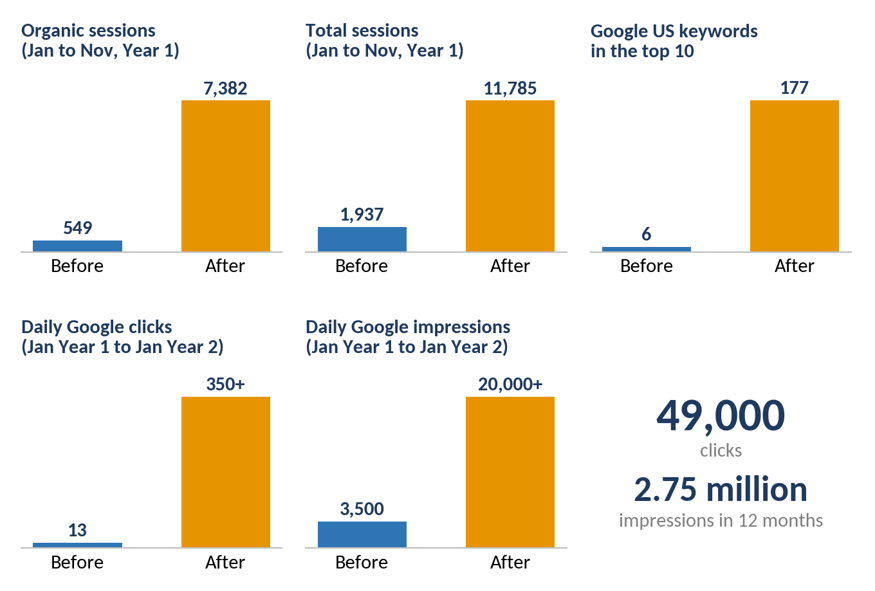
+1,244.62% organic sessions (549 to 7,382, January to November of Year 1)
Over a 12-month engagement, Digital Success took a SaaS platform's organic traffic from 549 sessions in January of Year 1 to 7,382 in November of Year 1, grew total sessions 508%, and moved Google top-10 rankings from 6 keywords to 177. Search Console showed 49,000 clicks and 2.75 million impressions over the year.
+1,245%
organic sessions
6 to 177
Google top-10 keywords
27x
daily Google clicks
2.75M
impressions in 12 months
The challenge: a crowded market and brand-only traffic
The client competes in a market full of established players and saturated content. Their marketing wasn't paying off, and their search presence showed it:
- Low visibility in search results.
- Only branded searches brought in organic traffic.
- A lot of content had been produced but wasn't earning traffic or links.
- Poor return on the marketing investment.
Our SaaS SEO approach: fix the foundation, then amplify what already exists
Rather than simply publish more content, we made the existing content work harder. The strategy had seven parts:
- Technical SEO audit. An exhaustive review of every technical factor that affects search performance.
- Keyword-led content clean-up. Existing content was cleaned and refocused on the best-fit keywords.
- Content syndication. Existing content was syndicated aggressively to widen its visibility.
- Link acquisition. An advanced campaign targeting competitors and the top-ranking results for the client's intended keywords.
- Search Console-led page optimization. Page-level, on-site micro-optimizations driven by Google Search Console data.
- Internal linking improvements across the site.
- Digital Success's "Seven DS Magic Tweaks" applied to every top landing page.
The results: from 6 to 177 top-10 keywords
| Metric | Starting point | End point | Change |
|---|---|---|---|
| Organic sessions | 549 (Jan, Year 1) | 7,382 (Nov, Year 1) | +1,244.62% |
| Total sessions (all channels) | 1,937 (Jan, Year 1) | 11,785 (Nov, Year 1) | +508.41% |
| Google US keywords in top 10 | 6 (Jan, Year 1) | 177 (within 12 months) | 177 vs. 6 |
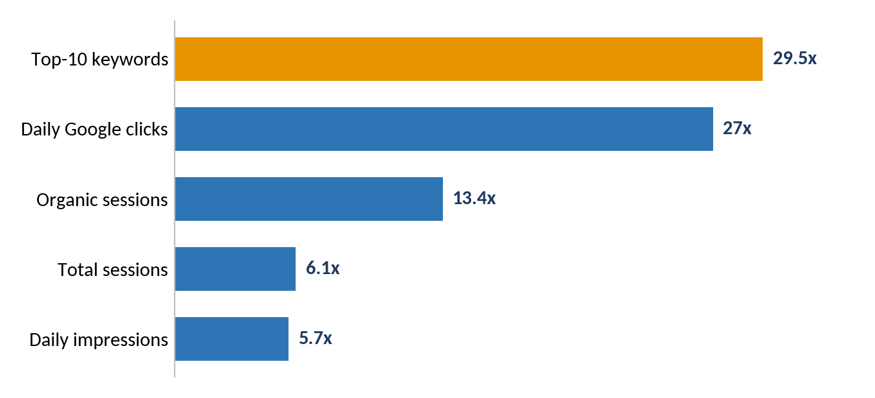
| Daily Google search clicks | 13 (Jan, Year 1) | 350+ (Jan, Year 2) | 27x |
| Daily Google search impressions | 3,500 (Jan, Year 1) | 20,000+ (Jan, Year 2) | 5.7x |
Over the 12 months, the site collected 49,000 clicks and 2.75 million impressions from Google search.
From challenge to measured outcome
| Challenge | Measured outcome |
|---|---|
| Low visibility in search results | Google US top-10 keywords grew from 6 to 177; daily impressions rose from 3,500 to 20,000+ |
| Only branded searches brought in organic traffic | Organic sessions grew from 549 to 7,382 (+1,244.62%) |
| Plenty of content, little traffic | 49,000 clicks and 2.75 million impressions from Google search over the 12 months |
How to read the sections that follow. Each section carries a tag. Campaign evidence means activities and results documented in this engagement. Industry context and recommended practice are general guidance from Digital Success; they were not measured in this campaign and are not results. Illustrative examples are labeled as such and are not client data.
Why SaaS SEO Is Different in a Crowded Category
CAMPAIGN EVIDENCE + INDUSTRY CONTEXT
In most software categories, dozens of established vendors compete for the same non-branded searches, and review sites, comparison pages and roundup articles can occupy much of the first page. A SaaS SEO program rarely wins by publishing more pages alone. It wins by making each page earn visibility for a specific search intent, and by building the authority that lets that page compete.
That is the situation this client was in. The documented starting point was brand-only: organic traffic came only from searches for the company's own name, even though a lot of content had already been produced. The table below shows why that matters.
The visibility gap: brand searches vs. category searches
| Consideration | Brand searches | Category and problem-led searches |
|---|---|---|
| Who is searching | People who already know the company | Prospects still choosing between vendors |
| Competition | Low; the company usually ranks first for its own name | High; established vendors, review sites and comparison pages |
| What SEO has to do | Keep results accurate and protected | Match intent with the right page, build authority, link internally |
| Status at the start (documented) | The only source of organic traffic | Low visibility in search results; 6 Google US keywords in the top 10 in total |
| Reported change (documented) | Not reported separately | Top-10 keywords rose from 6 to 177. The report does not split branded and non-branded terms. |
What the campaign did about it (documented): Rather than publish more, the team cleaned up and refocused existing content on best-fit keywords, syndicated it, built links aimed at competitors and the top-ranking results for the client's intended keywords, and improved internal linking. Those are the levers most relevant when a SaaS company's organic traffic is limited to its own brand name.
How SaaS Buyers Search
INDUSTRY CONTEXT + ILLUSTRATIVE EXAMPLES (NOT THE CLIENT'S REPORTED KEYWORD SET)
SaaS buyers rarely go from a problem to a purchase in one search. They move through stages, and each stage rewards a different kind of page. The query formats below are illustrative; the client's actual keyword targets were not published in this case study.
| Buyer stage | Illustrative query format | Page that fits | Typical intent |
|---|---|---|---|
| Problem-aware | "how to improve employee engagement" | Guides, explainers, templates | Informational |
| Category-aware | "employee engagement software" | Category or solution page, buyer's guide | Commercial investigation |
| Comparing vendors | "[category] software comparison", "[vendor] alternatives" | Comparison and alternatives pages | Commercial |
| Ready to evaluate | "[category] software pricing", "[product] demo" | Pricing, features, demo pages | Transactional |
| Validating a choice | "[product] reviews", "[product] case study" | Case studies, integrations, review profiles | Commercial |
Brand-only traffic means the site was visible mainly to people who already knew the company. The documented mechanisms for reaching earlier-stage searches were the keyword-led clean-up of existing content and the page-level optimization driven by Google Search Console data. The case study does not say which buyer stages the 177 top-10 keywords map to.
Is your SaaS traffic still mostly brand searches?
We will review where your organic visits come from and show which category searches you are missing.
Beyond Traffic: Measuring SaaS SEO Performance
CAMPAIGN EVIDENCE (CALCULATIONS USE REPORTED FIGURES ONLY)
Sessions are the headline, but the reported figures also let us read more of the story. The calculations below use only numbers already in this case study. These are Digital Success's arithmetic, not separately reported metrics.
| Measure | How it is calculated | Result | What it suggests |
|---|---|---|---|
| Organic share of all sessions | 549 / 1,937 (Jan, Year 1) and 7,382 / 11,785 (Nov, Year 1) | About 28% rising to about 63% | Organic search went from a minor source of visits to the main one in the reported months |
| Average click-through rate, full year | 49,000 clicks / 2.75 million impressions | About 1.8% | A blended average across all queries, branded and non-branded |
| Daily click-through rate, start vs. end | 13 / 3,500 and 350+ / 20,000+ | About 0.4% rising to about 1.75% (approximate, because end points were reported as "350+" and "20,000+") | Clicks grew faster (27x) than impressions (5.7x), which is consistent with pages moving to higher positions |
What this case study does not report: the branded vs. non-branded split, trial, demo or sign-up conversions, pipeline or revenue, rankings by keyword, and backlink counts. For a SaaS company, SEO is ultimately judged against pipeline, so the recommended reporting chain is: organic sessions, then engaged sessions, then demo or trial requests, then sales-qualified opportunities, then revenue influenced, each split by branded and non-branded queries and by page type. That chain is a recommended practice, not something reported here.
SaaS SEO in the Age of AI Search
INDUSTRY CONTEXT + RECOMMENDED PRACTICE (NOT MEASURED IN THIS CAMPAIGN)
Buyers increasingly meet an answer before they meet a link. AI-generated summaries in Google results, AI assistants and chat-based search tools now sit beside the classic results list. This campaign did not measure visibility in those environments, so nothing below is a campaign result. The practical point is that the fundamentals this campaign relied on carry over:
- Crawlable, well-structured pages. The technical audit (documented) covers prerequisites for any system, traditional or AI-driven, to find and read a page.
- Plain-language answers on category pages. State what the product does, who it is for and how it differs, in wording that can be quoted accurately.
- Consistent descriptions beyond your own site. Content syndication and link acquisition (both documented) place the brand on other sites. A consistent description across those mentions makes it easier for buyers and AI systems to describe the product correctly.
- Separate tracking. Monitor referral traffic from AI tools in analytics and periodically check how assistants describe the brand and its category. Measurement methods are still maturing, so treat this as directional.
Competing in a crowded software category?
Our SaaS link building team targets the sites that already rank for your keywords.
What Other SaaS Companies Can Learn From the Campaign
CAMPAIGN EVIDENCE, THEN RECOMMENDED APPLICATION
| Lesson | What happened here (documented) | How to apply it (recommended) |
|---|---|---|
| Audit before you add | A technical SEO audit reviewed every technical factor that affects search performance | Resolve crawl, indexing and speed problems before commissioning more content |
| Improve what you already have | Existing content was cleaned up and refocused on best-fit keywords; page-level changes were driven by Search Console data | Map each page to one primary intent, and review queries that earn impressions but few clicks |
| Earn links where rankings are decided | Link acquisition targeted competitors and the top-ranking results for intended keywords | Study who links to the pages that outrank you and pursue relevant sources; let those gaps drive SaaS link building |
| Distribute existing assets | Content was syndicated aggressively to widen visibility | Syndicate with care: ask partners to use canonical tags or clear attribution so your original page stays the preferred version |
| Connect your pages | Internal linking improved across the site; the Seven DS Magic Tweaks were applied to top landing pages | Link from high-traffic informational pages to the commercial pages that should convert |
Key takeaways for SaaS companies
- Content volume isn't the lever. This client already had plenty of content. Cleaning it up, syndicating it and linking to it did the heavy lifting.
- Competitor-focused link building works in saturated niches. Targeting the sites that already rank for your keywords puts you where buyers are looking.
- Search Console data shows where to optimize. Page-level fixes based on real query data beat guesswork.
Frequently asked questions
Organic sessions grew from 549 in January of Year 1 to 7,382 in November of Year 1 (+1,244.62%), as part of a 12-month engagement.
A technical SEO review, keyword-led content clean-up, content syndication, competitor-targeted link acquisition, Search Console-based page optimization, internal linking improvements and Digital Success's Seven DS Magic Tweaks on top landing pages.
177 keywords reached the top 10 positions on Google US within 12 months, up from 6 in January of Year 1.
A global SaaS employee engagement platform, six years in business, in a competitive niche with many established competitors.
SaaS SEO is the practice of earning search visibility for the problems, categories and comparisons a software company's buyers search for, not only its own brand name. In this case it combined a technical audit, content clean-up, syndication, link acquisition and Search Console-led optimization.
No. The reported results cover organic sessions, total sessions, Google US top-10 keywords, clicks and impressions. Trial, demo, pipeline and revenue figures were not part of the published results.
What This Case Study Does and Does Not Establish
This page documents what Digital Success did and the results reported above. It is not a controlled experiment, and some questions cannot be answered without data that was not published.
What the reported evidence supports
- Organic sessions, top-10 keyword count, clicks and impressions all rose substantially from the January Year 1 baseline during the 12-month engagement.
- The program combined a technical audit, content clean-up, syndication, competitor-targeted link acquisition, Search Console-led optimization, internal linking and top-landing-page tweaks, and the gains followed that combined program.
What it does not establish without additional data
- Which individual tactic produced how much of the gain. The tactics were applied together.
- The mix of branded and non-branded queries behind the end-point figures, or which buyer stages the keywords serve.
- Any effect on trials, demos, pipeline or revenue.
- That another company would see the same growth. The starting point was small (549 organic sessions), which makes large percentage gains easier than on an established base.
- Like-for-like comparisons across metrics. Sessions are reported January to November of Year 1, while daily clicks and impressions run from January of Year 1 to January of Year 2.
Want results like these for your SaaS product?
Our SaaS SEO team can audit your site and show you where the quickest wins are.
Get a free SEO audit Call +1-855-344-4821