




Supplement Spot was spending heavily on PPC without a return. We restructured the account and built campaigns around how its customers actually buy.
Client
Supplement Spot, a leading US supplement brand known for anti-aging and natural health products
Industry
Ecommerce / health supplements
Services
PPC management: Google Ads and Bing Ads, Google Shopping, retargeting, landing page and conversion optimization
Best-selling range
Dietary, skin and beauty products
Headline result
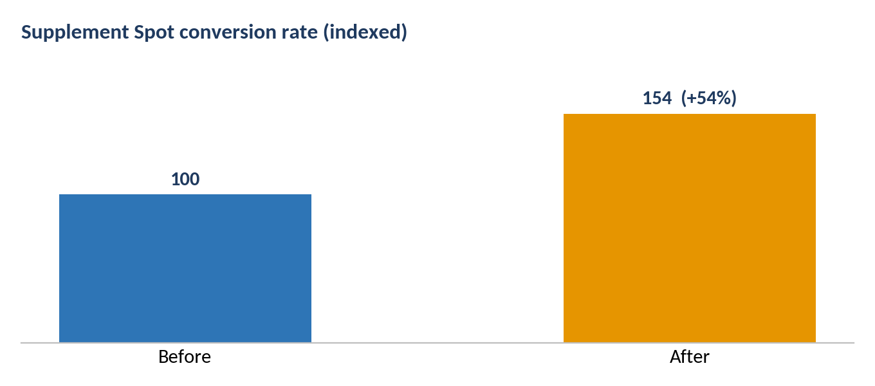
+54% conversion rate
Digital Success improved Supplement Spot's conversion rate by 54% by restructuring its Google Ads account, pruning keywords, rewriting ad copy, building Google Shopping campaigns around customer purchase behavior, optimizing landing pages and adding retargeting.
+54%
conversion rate
4
paid channels: Google Ads, Bing Ads, Shopping, retargeting
The challenge: high ad spend, no return
Supplement Spot is well known for its anti-aging and natural health supplements, and its dietary, skin and beauty products are its strongest sellers online. The brand was running PPC campaigns and spending heavily, but the campaigns weren't delivering results. Transactions were coming in, but the return on investment wasn't there.
Our supplement PPC approach: study the products, then rebuild the campaigns
We started by studying Supplement Spot's whole product range, including its best sellers, and identified every area where the campaigns could improve.
| Area | What we did |
|---|---|
| Account structure and keywords | Revisited the existing Google Ads account structure, pruned keywords and reworked ads |
| Ad copy and offers | Improved ad copy, and worked with the client on discounts and offers to raise conversion rate, featured prominently in ads |
| Shopping, search and retargeting | Analyzed customers' purchase behavior and niche to design Google Shopping campaigns, and ran Google and Bing paid search and retargeting campaigns |
| Landing page and conversion | Developed the landing page to maximize conversion rate, and monitored and tuned campaigns regularly |
The results
| Metric | Result |
|---|---|
| Conversion rate | +54% |
| Transactions | Improved |
How to read the sections that follow. Each section carries a tag. Campaign evidence means activities and results documented in this engagement. Industry context and recommended practice are general guidance from Digital Success; they were not measured in this campaign and are not results. Illustrative examples are labeled as such and are not client data.
How Supplement Shoppers Search and Buy
INDUSTRY CONTEXT + ILLUSTRATIVE EXAMPLES (NOT SUPPLEMENT SPOT'S REPORTED KEYWORD SET)
Supplement shoppers search by need, by ingredient, by product type and by brand, and many compare options before buying. In paid search, those intents deserve different campaign structures. The formats below are illustrative; Supplement Spot's actual keywords and product groups were not published.
| Search intent | Illustrative format | Best-fit paid format | Role in the funnel |
|---|---|---|---|
| Benefit or need | "[benefit] supplement", "anti-aging supplement" | Search ads to a category landing page | Discovery |
| Ingredient | "[ingredient] supplement" | Search and Shopping | Evaluation |
| Product type | "skin and beauty supplement", "dietary supplement" | Google Shopping, search | Evaluation and purchase |
| Brand | "[brand] [product]" | Brand search ads | Capturing existing demand |
| Comparison and reviews | "[product] vs [product]", "[brand] reviews" | Shopping, retargeting | Reassurance |
| Return visits | Not search-led | Retargeting | Re-engaging past visitors |
Documented in this campaign: the team analyzed customers' purchase behavior and niche to design the Google Shopping campaigns, ran Google and Bing paid search, and added retargeting. The case study does not publish the keyword or product-group structure.
Paying for clicks that do not convert?
Landing page and offer testing was part of this rebuild. See how it works for your account.
Beyond Conversion Rate: Measuring Supplement PPC Profitability
CAMPAIGN EVIDENCE + RECOMMENDED PRACTICE
Supplement Spot's starting problem was a return problem, not a volume problem: transactions were coming in, but the return on investment was not. The reported result is a 54% improvement in conversion rate (indexed, 100 to 154), with transactions described as improved. Conversion rate is the right first lever for that situation, but it is not, by itself, proof of profitability.
| Metric | What it tells you | Reported here? |
|---|---|---|
| Conversion rate | The share of clicks that become orders | Yes: +54% (indexed) |
| Transactions | Order volume | Described as "improved"; no figures |
| Cost per acquisition | What each order costs in ad spend | No |
| Return on ad spend | Revenue generated per dollar of ad spend | No |
| Average order value | Whether orders are growing or shrinking | No |
| Margin after ad cost | Whether the program is profitable | No |
Illustrative arithmetic, not a reported result. Cost per acquisition equals cost per click divided by conversion rate. If cost per click had stayed constant, a 54% higher conversion rate would cut cost per acquisition by about 35%. The case study does not report cost per click or spend, so the actual effect on acquisition cost cannot be confirmed from it.
Advertising Supplements: Claims, Policies and Landing Page Trust
INDUSTRY CONTEXT (NOT CAMPAIGN DATA; NOT LEGAL ADVICE)
Supplements are a closely scrutinized category. Ad platforms maintain policies that restrict certain health claims and ingredients, and U.S. regulators such as the FTC and FDA set expectations for how supplements are marketed, including substantiation for health-related claims. These rules change, so advertisers should check current Google Ads, Microsoft Advertising and regulatory guidance directly. The case study does not describe any compliance work.
What this means for supplement PPC management in practice:
- Write ads and landing pages within claims you can substantiate. Review copy against current platform policies before launch.
- Lead with concrete offers. The campaign featured discounts and offers prominently in ads (documented). An offer gives an ad something specific to promise that does not depend on a health claim.
- Build trust on the landing page. Clear ingredient information, shipping and return terms, and visible reviews, where available, support conversion for a category buyers approach carefully.
Ready to add organic search to your paid strategy?
Use what your paid data reveals to build lasting ecommerce visibility.
PPC and SEO Together: Using Paid Data to Guide Organic Growth
RECOMMENDED PRACTICE (NO ORGANIC SEARCH WORK IS DOCUMENTED IN THIS CAMPAIGN)
This engagement was paid media only. For ecommerce brands, though, paid search is a fast source of search-intent data that can also inform an organic strategy:
- Search term reports show the exact phrases behind converting clicks. Strong performers are candidates for category-page and content optimization.
- Shopping performance by product shows which products convert, indicating where product-page copy, reviews and structured data deserve investment.
- Landing page tests that lift paid conversion rate, like the landing page work documented here, can inform the design of organic landing pages.
- Paid search delivers controllable demand quickly; organic search builds visibility that compounds. Neither channel's long-term effect was measured in this case study.
Key takeaways for ecommerce PPC management
- Spend isn't the same as return. Transactions alone didn't mean the campaigns were profitable. The fix was structure, targeting and conversion optimization.
- Match campaigns to buyer behavior. Google Shopping campaigns were designed around how Supplement Spot's customers purchase.
- Fix the landing page, not just the ad. Conversion rate rose when the ad, offer and landing page worked together.
Supplement PPC Case Study FAQs
Conversion rate improved by 54%, and transactions improved as well.
The brand was spending heavily on PPC and generating transactions, but without a return on investment. The campaigns needed a restructured account, better keywords and ads, stronger offers and a better landing page.
Google Ads paid search, Bing paid search, Google Shopping campaigns and retargeting campaigns.
In this case: studying the full product range, restructuring the ad account, pruning keywords, improving ad copy, building offers with the client, designing Shopping campaigns around purchase behavior, optimizing the landing page and monitoring campaigns closely.
Supplement PPC management is the planning, optimization and measurement of paid search, shopping and retargeting campaigns for supplement brands. In this case it covered restructuring a Google Ads account, pruning keywords, improving ad copy and offers, building Google Shopping campaigns and optimizing a landing page.
No. The reported result is a 54% improvement in conversion rate, with transactions described as improved. Return on ad spend, cost per acquisition, ad spend and revenue figures were not published.
What This Case Study Does and Does Not Establish
This page documents what Digital Success did and the results reported above. It is not a controlled experiment, and some questions cannot be answered without data that was not published.
What the reported evidence supports
- Conversion rate improved by 54% following the campaign rebuild (indexed to the starting level = 100), and transactions improved.
- The rebuild covered account structure, keyword pruning, ad copy and offers, Google Shopping, Google and Bing paid search, retargeting and the landing page.
What it does not establish without additional data
- Absolute conversion rates, ad spend, revenue or the measurement period.
- Whether return on investment turned positive, or by how much. Return was the stated problem, but it is not quantified.
- Which change drove the gain: structure, copy, offers, Shopping, retargeting or the landing page.
- Any effect on organic search visibility. No organic work is documented.
Spending on ads but not seeing the return?
Our PPC team will review your account and show you where budget is leaking.
Get a free PPC audit Call +1-855-344-4821