




An industrial products manufacturer wanted to be found online. A methodical SEO program made that happen.
Client
Therma-Flite, Inc., an industrial products manufacturer
Industry
Manufacturing / industrial products
Services
Manufacturing SEO: keyword research, on-page SEO, UX and content improvements, site speed, content marketing, off-page SEO
Goal
Boost online presence and strengthen search engine rankings
Headline result
+258% website traffic
Digital Success grew Therma-Flite's website traffic by 258% with a manufacturing SEO program built on keyword research, on-page optimization, faster site speed, stronger landing pages and a content marketing and off-page campaign.
+258%
website traffic
4
workstreams: keywords, on-page, speed, content and off-page
The challenge: getting an industrial brand found online
Therma-Flite, Inc. manufactures industrial products using a blend of established technologies and innovative techniques, processes and methods. The company wanted to boost its online presence and strengthen its rankings on search engines, so that buyers searching for industrial products could find it.
Our approach: a methodical manufacturing SEO strategy in four parts
| Workstream | What we did |
|---|---|
| 1. Keyword research and targeting | Researched the client's keywords thoroughly, then worked to improve rankings for the most relevant ones |
| 2. On-page SEO, content and UX | Optimized on-page SEO elements extensively and improved content and user experience on all the top landing pages |
| 3. Site speed | Improved website speed and optimized website content to give traffic an extra boost |
| 4. Content marketing and off-page SEO | A content marketing campaign with syndication, guest blogging and related channels, plus business listings, press release syndication and video promotion |
The results
| Metric | Result |
|---|---|
| Website traffic | +258% |
How to read the sections that follow. Each section carries a tag. Campaign evidence means activities and results documented in this engagement. Industry context and recommended practice are general guidance from Digital Success; they were not measured in this campaign and are not results. Illustrative examples are labeled as such and are not client data.
Why SEO Is Different for Industrial and Manufacturing Companies
INDUSTRY CONTEXT, TIED TO THIS CAMPAIGN
Industrial SEO differs from consumer SEO because of who is searching and what is at stake. Engineers, plant managers and procurement teams often research a purchase over weeks or months, involve several colleagues, and judge suppliers on specifications, standards and proof of capability rather than brand appeal. Their queries are longer and more technical, and each one tends to match a narrow set of pages.
For a manufacturer like Therma-Flite, which makes industrial products using a blend of established technologies and innovative techniques, processes and methods, that has practical consequences:
- Specificity wins. Pages have to describe products, processes and applications in the buyer's own terms.
- Trust is part of conversion. Case studies, certifications and capability detail help both search engines and buyers judge credibility.
- Technical hygiene matters on heavy sites. Large images, technical diagrams and downloadable files can slow pages down.
- Quality beats volume. Search volumes for specific industrial queries are often modest, so the relevance of each visitor matters more than the raw count.
Documented in this campaign: the program addressed several of these directly, through keyword research on the terms buyers use, extensive on-page optimization, content and user experience improvements on all top landing pages, and site speed work.
How Industrial Buyers Search
INDUSTRY CONTEXT + ILLUSTRATIVE EXAMPLES (NOT THERMA-FLITE'S REPORTED KEYWORD SET)
Industrial queries fall into recognizable patterns. The formats below are illustrative; Therma-Flite's keyword targets were not published in this case study.
| Search pattern | Illustrative format | What the buyer needs | Page that should answer |
|---|---|---|---|
| Specification | "[product type] [material] [size or rating]" | An exact match to a technical requirement | Product page with a specification table and datasheet |
| Application | "[product type] for [industry or use case]" | Evidence it works in their setting | Application or industry page |
| Comparison | "[product A] vs [product B]", "alternative to [brand]" | A fair, factual comparison | Comparison or selection guide |
| Standards | "[product] [standard or certification]" | Proof of compliance | Certification and compliance page |
| Supplier and capability | "[process] manufacturer", "[product] supplier [region]" | Evidence of capacity, quality and location | Capability, facility and case study pages |
| Research | "how to choose [product type]" | Education before shortlisting | Guides, FAQs, technical articles |
Therma-Flite's documented approach, researching its keywords thoroughly and then working on rankings for the most relevant ones, reflects the same principle: start from the terms buyers use and build the page to match.
The visibility gap: products vs. applications
Manufacturers tend to describe what they make; buyers often search for what they need to accomplish. A site organized around internal product names can rank for the company's own terminology and still miss searches framed by application, material or standard. Closing that gap usually means adding application- and industry-led pages alongside product pages, and linking the two in both directions. Whether Therma-Flite's site had such a gap was not reported, so treat this as a recommended check rather than a finding.
Do your pages match how industrial buyers search?
Start with a keyword review built around your products, applications and standards.
Manufacturing Website Pages That Attract Traffic
CAMPAIGN EVIDENCE + RECOMMENDED PRACTICE
The table separates what this campaign documents from what industrial sites typically need. The case study confirms the type of work done on top landing pages, but does not itemize the pages themselves.
| Page type | Buyer intent | What it should contain | Status in this campaign |
|---|---|---|---|
| Product and category pages | Commercial: shortlisting suppliers | Specifications, variants, datasheets, compressed images | Top landing pages received on-page, content and UX improvements (documented); page types not itemized |
| Application and industry pages | Commercial: confirming fit | Use case, results, related products | Not documented; recommended |
| Capability and process pages | Supplier evaluation | Processes, capacity, quality systems, certifications | Not documented; recommended |
| Case study pages | Validation | Problem, solution and measured result | Not documented as a workstream; recommended |
| Technical articles and FAQs | Research | How-to-choose guides, definitions, standards explained | A content marketing campaign with syndication and guest blogging ran (documented); topics not published |
Site speed deserves a separate note. Industrial pages often carry heavy images, diagrams and downloads. Improving website speed and optimizing website content was one of the four documented workstreams.
Beyond Traffic: Measuring Industrial SEO Performance
CAMPAIGN EVIDENCE + RECOMMENDED PRACTICE
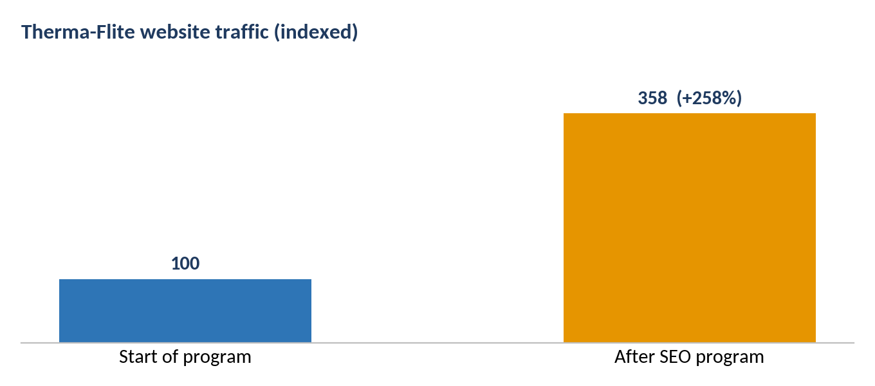
The reported result is a 258% increase in website traffic. Absolute traffic figures were not published, which is why Figure 1 is indexed (start = 100, end = 358). The case study also does not state whether that figure covers organic search traffic only or all sources.
Traffic is a useful visibility signal, but for a manufacturer the commercial outcome is a request for quote, a specification inquiry or a distributor contact.
| Measure | Reported here? | Why it matters for a manufacturer |
|---|---|---|
| Website traffic | Yes: +258% (indexed) | A visibility signal |
| Rankings for target keywords | No | Shows whether traffic comes from commercially relevant terms |
| Organic traffic by landing page | No | Shows which page types attract buyers |
| RFQs, form submissions and calls | No | The commercial outcome of the traffic |
| Lead quality | No | Separates qualified buyers from noise |
| Pipeline and revenue | No | The business case for continued investment |
Turning organic traffic into qualified leads (recommended practice)
- Place a clear, specification-aware call to action, such as requesting a quote or talking to an engineer, on product and application pages.
- Track form submissions, calls and downloads as conversions in analytics, segmented by landing page.
- Review incoming inquiries with sales to separate qualified requests from noise, and feed that back into keyword priorities.
Want RFQs, not just more traffic?
Talk to a specialist about tracking inquiries from organic search.
Industrial SEO in the Age of AI Search
INDUSTRY CONTEXT + RECOMMENDED PRACTICE (NOT MEASURED IN THIS CAMPAIGN)
Engineers and buyers increasingly use AI assistants and AI-generated search summaries for a first view of options, materials and standards. This campaign did not measure visibility in those environments. For industrial companies, the practical implications are:
- Publish facts that can be quoted accurately. Put specifications, materials and certifications in page text, not only in images or downloads.
- Make capability and application pages explicit. State what you make, for which industries and under which standards.
- Keep company details consistent. The campaign included business listings, press release syndication and video promotion (documented). Consistent descriptions across those channels help buyers and AI systems describe the company correctly.
- Show proof. Case studies and documented results give both people and AI tools something concrete to cite.
- Monitor. Watch referral traffic from AI tools and test prompts about your product category from time to time.
Key takeaways for manufacturing SEO
- Start with the keywords buyers actually use, then build pages around them.
- Landing page quality and site speed matter. Both were part of the program alongside on-page SEO.
- Combine on-site and off-site work. Content syndication, guest blogging, listings, press releases and video all supported the traffic growth.
Manufacturing SEO Case Study FAQs
Website traffic grew 258% during Digital Success's SEO engagement.
Keyword research, on-page SEO, improved content and user experience on top landing pages, site speed work, a content marketing campaign with syndication and guest blogging, and off-page work including business listings, press release syndication and video promotion.
Therma-Flite, Inc. is an industrial products manufacturer that blends established technologies with innovative techniques, processes and methods.
Yes. In this case, a focused program of keyword research, on-page optimization, speed improvements and content marketing helped an industrial manufacturer grow website traffic by 258%.
Manufacturing SEO is search engine optimization for manufacturers and industrial suppliers. It focuses on the technical, specification- and application-led searches that engineers and procurement teams use to find suppliers. In this case it combined keyword research, on-page optimization, site speed work, content marketing and off-page promotion.
No. The published result is a 258% increase in website traffic. Absolute traffic, rankings, RFQ and lead figures were not published.
What This Case Study Does and Does Not Establish
This page documents what Digital Success did and the results reported above. It is not a controlled experiment, and some questions cannot be answered without data that was not published.
What the reported evidence supports
- Website traffic grew 258% during the SEO program (indexed to the starting level = 100).
- The program included keyword research, on-page SEO, content and UX improvements on top landing pages, site speed work, content marketing and off-page promotion.
What it does not establish without additional data
- Absolute traffic levels, the program's time period, or whether the figure covers organic search only or all traffic sources.
- Which workstream contributed most. The work was delivered together.
- Rankings for specific keywords, or whether the added traffic came from relevant buyers.
- RFQs, leads, sales or revenue.
Is your manufacturing company easy to find online?
Get a free SEO audit and a clear picture of where your site stands against competitors.
Get a free SEO audit Call +1-855-344-4821